
Canada Type Approval Summary
Canada is one of the largest and most technologically advanced telecommunications markets. According to Mordor Intelligence, in terms of market size and value, the country’s information and communications technology (ICT) sector and digital infrastructure are supported by a customer base of more than 35 million mobile users and 16 million fixed-line broadband subscribers out of a total population of approximately 41 million.
This makes Canada an attractive market for manufacturers and importers to place ICT devices on the Canadian market. It is important to note, however, that the market is still dominated by a handful of major players and that service rates are relatively high by global standards.
Additionally, before marketing ICT devices in Canada, manufacturers and importers need to be aware of the applicable local compliance requirements. This compliance requirement is commonly referred to as “ISED Certification.”
ISED stands for Innovation, Science and Economic Development Canada. It is the authority responsible for fostering a competitive, knowledge-based economy in Canada.
Under ISED is the Certification and Engineering Bureau (CEB), which is responsible for activities related to the testing and certification of radio equipment, as well as the registration of terminal equipment. The CEB administers and oversees the certification framework for radio equipment in Canada, while recognized Certification Bodies (CBs) may assess compliance and issue certificates in accordance with ISED requirements.
Understanding the process and requirements for obtaining an ISED certification will make it easier for manufacturers and importers to enter this large and advanced Canadian market.
Who Can Be an Applicant?
- Local representative
- Required
Applying for certification of radio equipment in Canada is not a simple matter. Foreign manufacturers may appoint a Canadian representative to support the certification process and act as a local point of contact when required by ISED procedures. Where a Canadian representative is designated, the applicant must submit a signed Application Form and Certification Service Agreement that clearly identifies the representative’s details.
The Canadian representative is responsible for responding to inquiries related to the certified product, including providing audit samples to ISED free of charge when requested. The applicant must maintain a valid Application Form and Certification Service Agreement for as long as the certified product is marketed in Canada.
Application Method
- In-country testing
- No
Radio equipment certification in Canada is governed by the Radio Standards Specification General Requirements (RSS-Gen). The certification procedures and application requirements are outlined in Radio Standards Procedure RSP-100.
Products must meet the requirements established by ISED, as specified in the Radio Standard Specifications (RSS). ISED also references certain ANSI C63 standards for specific testing and measurement requirements. Testing must be conducted at an ISED-recognized testing laboratory.
Equipment that is determined to comply with the applicable requirements may receive a certificate issued either by the Certification and Engineering Bureau (CEB) of ISED or by an ISED-recognized Certification Body (CB). Certification applications may be submitted through recognized CBs, which are authorized to assess compliance and issue certificates on behalf of the certification framework.
Product Category
Category I equipment consists of radio apparatus that requires a technical acceptance certificate (TAC) issued by the Certification and Engineering Bureau (CEB) of ISED or a certificate issued by a recognized certification body (CB).
Category I equipment shall be certified using the procedures and requirements specified in RSP-100. The test report shall not be dated more than 12 months before the submission of the application for equipment certification.
Category II equipment is exempt from certification; therefore, neither a TAC issued by the CEB nor a certificate issued by a recognized CB is required.
However, Category II equipment must meet all applicable standards when it is manufactured, imported, distributed, rented, offered for sale, or sold in Canada. Test reports must be retained for as long as the radio equipment model is manufactured, imported, distributed, sold, offered for sale, and/or rented in Canada, and must be submitted to ISED upon request.
Certification Bodies
Applicants may use a recognized Certification Body (CB) to submit their application. This is an external body designated by ISED to assess compliance with requirements and issue certificates.
Currently, there are 35 CBs available, located in various countries such as the United States, the United Kingdom, Germany, the Netherlands, Austria, Spain, and Singapore, as well as in Canada itself.
Many recognized Certification Bodies also operate accredited testing laboratories, allowing applicants to obtain testing and certification services from the same organization. Thus, applicants can also use them as testing facilities for their products.
Accredited Laboratories
Product testing must be conducted at a testing laboratory accredited by ISED. As explained, most Certification Bodies are also accredited testing laboratories. However, some act solely as testing laboratories to issue test reports (they are not authorized to issue certificates).
Applicants must pay attention to the testing laboratory’s scope of testing. If the scope is not covered, the test report may not be accepted.
Sample Requirements
Generally, samples are not required, as there is no obligation to conduct local testing for ISED certification in Canada. Samples are generally required only when product testing has not yet been completed, and testing must be performed by an accredited laboratory participating in the certification process.
Sample requirements depend on the equipment used and which RSS or standard applies. The number and condition of the samples will also be determined by the relevant laboratory.
Document Requirements
Document checklist for certification:
- Application Cover Letter
- A completed and signed copy application form
- A completed and signed copy Test Report Cover Sheet
- Canadian Representative Letter
- Agent/Authorization Agreement
- Test Report
- Internal and External photos of the product versions in the application
- Product manual with applicable user notifications and operational description
- Schematics, block diagrams and parts list
- Physical label and label location photo(s) or illustration of the product label
Submission process
- Submission
- Online
Once all documents are complete, submit them to https://ised-isde.canada.ca/site/spectrum-management-system/en/online-registration if using the CEB of ISED. If using a CB, each body has its own procedures. However, submissions are generally made online.
Lead Time of Certification
- Lead time
- Typically 4-6 weeks
The official ISED certification framework does not specify a fixed certification timeline. In practice, the certification process typically takes around 4-6 weeks, although the actual duration may vary depending on testing requirements, product complexity, application completeness, and certification review activities.
Validity Period
- Validity
- Permanent
This certificate is valid indefinitely, provided there are no changes to the product or the certificate holder. When ISED updates an applicable technical standard, products must conform to the rules in force at the time of manufacture, import, or sale. If a standard changes, manufacturers may need to update test reports to demonstrate continued compliance, though Category I equipment typically does not require re-submitting the full certification
Label Requirements for Canada Type Approval
- Product label
- Required
- Approval mark
- Required
- E-labeling
- Allowed
This label shall be permanently affixed to each unit of the equipment or displayed electronically (e-labelling) and its text shall be indelible and clearly legible.
A physical label must be affixed if the longest dimension of the equipment is greater than 2.5 cm. If the largest dimension of the equipment is equal to or smaller than 2.5 cm the label may be placed in the user manual instead of on the unit itself or be placed on the product packaging.
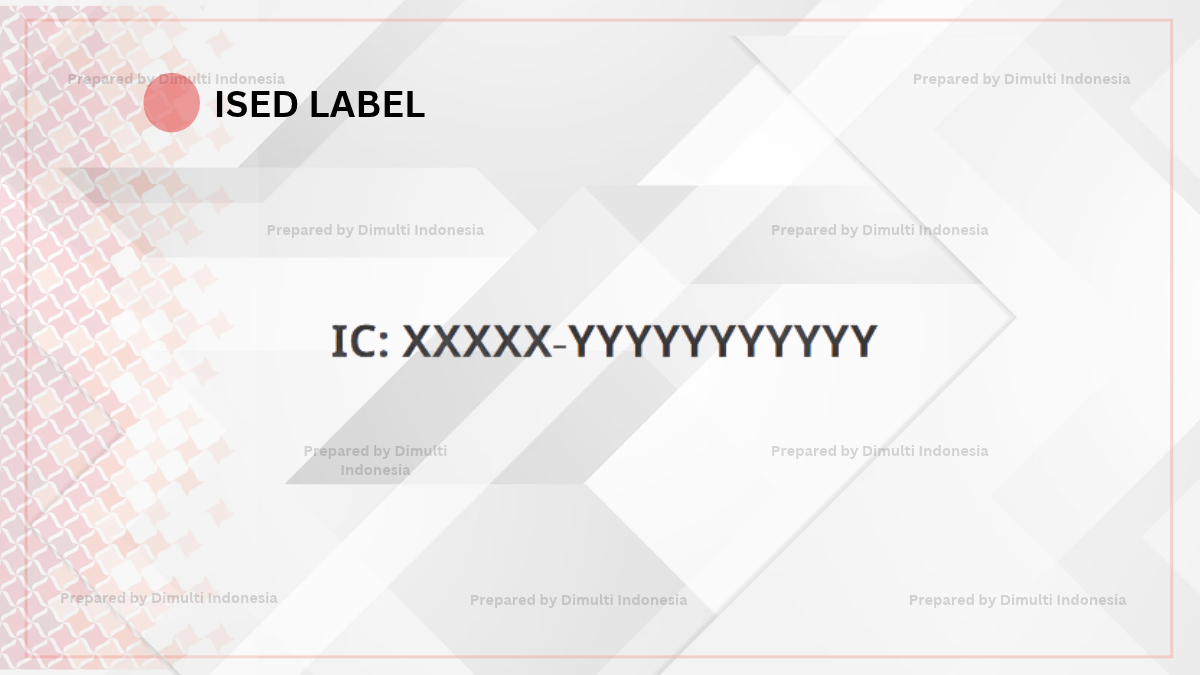
ISED Label
The certification number shall start with the company number (CN) assigned by ISED, followed by the unique product number (UPN) assigned by the applicant. The certification number format shall be:
- "IC:" indicates that this is an ISED certification number, but is not part of the certification number
- "XXXXX" is the CN assigned by ISED and is made up of five numeric characters
- "YYYYYYYYYYY" is the UPN assigned by the applicant, made up of a maximum of eleven alphanumeric characters
- The characters in the CN and the UPN are limited to numeric (0‑9) and capital ISO basic Latin alphabetic (A‑Z) characters only; the use of punctuation marks or other symbols, including "wildcard" characters, is not permitted
Alternative Country Names
Dominion du Canada, Kanada, Kanata, 加拿大 (Jiānádà), カナダ, ᑲᓇᑕ, Ceanada, كندا
Rules by Technology
Allowed, approval required
- Wi-Fi 2.4 GHz
- Wi-Fi 5 GHz
- Wi-Fi 6E (6 GHz)
- Wi-Fi 7
- Bluetooth Classic
- Bluetooth Low Energy
- NFC
- RFID
- UWB
- Zigbee
- Thread
- Z-Wave
- DECT
- 2G/3G
- 4G LTE
- 5G NR
- NB-IoT
- LTE-M
- LoRa / LoRaWAN
- Sigfox
- Automotive radar (77 GHz)
- Short-range radar (24 / 60 GHz)
- GNSS (GPS)
- Satellite communication
- Wireless charging (Qi)
- PMR / Walkie-talkie
- Amateur radio
- Passive Optical Network (PON)
- Wavelength Division Multiplexing (WDM)
- Coaxial Cable
- ISDN
- Ethernet
- VoIP
- IPv6
- Power Line Carrier
- Microwave Link
- Free Space Optics
- Digital Audio Broadcasting (DAB)
Talk to our project handler
Send your product details and we reply with the ISED requirements, lead time and cost.
Request a quote