Author: Muhammad Rifqi Rihza Rahman

  • What is UWB? Learn Its History and How It Works

    What is UWB? Learn Its History and How It Works

    Ultra-wideband (UWB) is an innovative way of wireless data transmission that can be used for various applications such as voice, video, and data transfer.

    It turns out that ultra-wideband is an old technology, it is more than 100 years old. It was first used by Guglielmo Marconi, one of the Italian innovators in 1901 to transmit music from radio stations to ships at sea.

    In recent years many industry observers have claimed this technology has proven more successful than Bluetooth because it has superior speed, is cheaper, uses less power, is safer, and provides superior location discovery and device range.

    In this article, we will explain the history of UWB, how it works, and its regulation in Indonesia.

    What is UWB?

    UWB is a technology that enables high bandwidth data transmission over a very wide frequency range.

    Ultra-wideband signals can propagate over very long distances and are not affected by interference from other electronic devices.

    Ultra-wideband, often called impulse radio ultra-wideband (IR-UWB), is a technology that uses short pulses to transmit data through free space.

    Ultra-wideband can be passive or active, depending on the situation. Ultra-wideband does not contain any major drawbacks but does have some limitations in distance and frequency.

    To understand how Ultra-wideband works, you need to know what it is made of and what makes Ultra-wideband so unique from all the other types of technology out there today.

    History
    Ultra-Wideband (UWB) History, How it Works, and Regulations in Indonesia 3

    The history of this technology dates back to the time of the first man-made radio when Marconi used spark-gap transmitters (short electrical pulses) for wireless communications.

    In 1920, Ultra-wideband signals were banned for commercial use. Ultra-wideband technology is restricted to defense applications under a top-secret program for secure communications.

    It wasn’t until 1992 that Ultra-wideband began to receive real attention in the scientific community. The development of high-speed microprocessors and fast-switching techniques has made Ultra-wideband commercially viable for short-range, low-cost communications.

    Initial applications include radar systems, communications, consumer electronics, wireless personal area networks, localization, and medical electronics. Since then, detailed knowledge of Ultra-wideband electromagnetics, components, and systems engineering has been developed.

    In 2002, the US Federal Communications Commission (FCC) was the first organization in the world to issue Ultra-wideband regulations allowing unlicensed use of allocated spectrum.

    However, the permissible power limit is set very low to avoid interference with other technologies operating in this frequency band such as WiFi, Bluetooth, etc.

    The low spectral density of Ultra-wideband signals is attractive, making this technology less susceptible to in-band interference from other narrowband signals and very safe because it is difficult to detect due to its low power density.

    How it Works
    Ultra-Wideband (UWB) History, How it Works, and Regulations in Indonesia 2

    Ultra-wideband operates in the 3GHz to 30GHz range, which is significantly higher than the frequency bands used for most other types of wireless communications.

    This permits UWB signals to carry more information, making it a perfect arrangement for transmitting expansive records such as recordings or pictures.

    Ultra-wideband signals can moreover pass through impediments such as dividers and furniture, making them a great choice for indoor utilization.

    UWB moreover has a long-range, which makes this technology a successful communication strategy for gadgets such as remote security cameras.

    Ultra-wideband signals work by sending ultra-short pulses of energy with very fast rise and fall times (faster than the time it takes for sound to travel one foot). UWB signals can be used in two different ways: as a carrier wave or as a pulsed signal.

    Ultra-wideband carrier wave transmits data by modulating the UWB signal to create an RF carrier wave. Pulsed UWB transmits data by turning the UWB signal on and off at high speed, similar to Morse code.

    One of the main advantages of this technology is that it can use multiple frequencies to send data simultaneously, making it possible to achieve high data rates.

    UWB signals can also be used for UWB imaging, allowing them to scan objects and determine their shape.

    UWB technology is still in its infancy but has a promising future as we continue to develop new applications that can take advantage of UWB’s unique properties.

    Product Compliance and Regulations in Indonesia

    Ultra-Wideband (UWB) History, How it Works, and Regulations in Indonesia 4

    In the context of using Ultra-wideband in Indonesia, every tool or device that has a UWB feature must meet the testing standards set by the Ministry of Communication and Information through the Directorate General of Digital Infrastructure (DJID).

    Provisions regarding Ultra-wideband testing standards are regulated in Ministerial Decree (KEPMEN) Number 260 of 2024 of the Ministry of Communication and Digital (KOMDIGI).

    By the Ministerial Decree Number 260 of 2024, Ultra-wideband devices are required to go through a certification and testing process to ensure they are safe, do not interfere with other frequencies, and meet applicable quality standards.

    This process includes technical and safety tests to ensure the device can operate safely without causing interference to the surrounding frequency spectrum.

    With this certification, users can feel calm about using the device whose quality and security are guaranteed.

    For manufacturers or importers of UWB devices, obtaining type approval and certification from DJID is a mandatory step before the device can be officially marketed in Indonesia.

    To simplify the certification process, producers can utilize DJID certification services as a reliable solution.

    Complying with these regulations not only supports legal compliance but also encourages safer and wider use of Ultra-wideband technology in Indonesia. [UN]

  • The New Issued of RLAN Technical Requirements in Indonesia

    The New Issued of RLAN Technical Requirements in Indonesia

    As we know, previously Indonesia only had the technical standard of Wireless Local Area Network (WLAN), which is regulated by PERDIRJEN SDPPI NO 02 TAHUN 2019.

    However, the Ministry of Communication and Digital Affairs (KOMDIGI) on January 15th, 2025 released KEPMEN KOMDIGI NO 12 TAHUN 2025. This unused control talks particularly approximately the unused issue of Radio Local Area Network (RLAN) technical requirements in Indonesia.

    New Issued of RLAN Technical Requirements

    The modern issue of RLAN specialized prerequisite in Indonesia automatically was changing the control. One of the new issued RLAN technical requirements in Indonesia is almost the recurrence of RLAN.

    This article will educate you about the changing control of the new issued RLAN technical requirements in Indonesia which is controlled by KEPMEN KOMDIGI NO 12 TAHUN 2025.

    Regulation on PERDIRJEN SDPPI NO 02 TAHUN 2019

    The New Issued of RLAN Technical Requirements in Indonesia 2

    In the past direction which was directed by PERDIRJEN SDPPI NO 02 TAHUN 2019, the admissible WLAN groups are still restricted to:

    • 2400 – 2483.5 MHz (For Indoor and Open air Use)
    • 5150 – 5250 MHz (For Indoor Utilize Only)
    • 5250 – 5350 MHz (For Indoor Utilize Only)
    • 5725 – 5825 MHz (For Indoor and Open air Use)

    With the progression of WLAN or RLAN innovation, the assignments said over are not sufficient. We require indeed more extensive allotments to allow room for modern innovation to evolve.

    That’s why this January, KOMDIGI distributed the unused direction called “KEPMEN KOMDIGI NO 12 TAHUN 2025” concerning “Radio Recurrence Range Based on Lesson Permit and Specialized Benchmarks of Media Transmission Instruments And/or Media Transmission Gadgets for Radio Nearby Region Networks”.

    Updates From KEPMEN KOMDIGI NO 12 TAHUN 2025

    The New Issued of RLAN Technical Requirements in Indonesia 3

    After checking the modern KEPMEN KOMDIGI NO 12 TAHUN 2025, there are a few curious upgrades from this unused direction. The to begin with and most striking one is the recurrence assignment. Based on the to begin with the decree, we have unused allotments for RLAN advances in Indonesia, which are:

    • 2400 – 2483.5 MHz
    • 5150 – 5250 MHz
    • 5250 – 5350 MHz
    • 5725 – 5825 MHz
    • 5925 – 6425 MHz, and
    • 57 – 64 GHz

    These allotments are isolated into three classifications, which are:

    1. 2.4 GHz/5 GHz RLAN, with frequency and RF Output Power allocation as mentioned below:

    Operating Frequency2,4 GHz/5 GHz RLAN for type-1 access2,4 GHz/5 GHz RLAN for type-2 access or backhaul
    2400 – 2483,5 MHz≤ 27 dBm EIRP (500 mW)≤ 36 dBm EIRP
    5150 – 5250 MHz≤ 23 dBm EIRP (200 mW)–
    5250 – 5350 MHz≤ 23 dBm EIRP (200 mW)–
    5725 – 5825 MHz≤ 23 dBm EIRP (200 mW)≤ 36 dBm EIRP (4 Watt)

    2. 6 GHz RLAN, with frequency and RF Output Power allocation as mentioned below:

    Working FrequencyRLAN RF Output Power Limit (EIRP)
    Very Low Power (VLP)
    5925-6425 MHz≤ 23 dBm (200 mW)≤ 14 dBm (25 mW)

    3. 60 GHz RLAN, with frequency, channel bandwidth, and RF Output Power allocation as mentioned below:

    Testing ParameterBenchmark
    Operating Frequency57-64 GHz
    Channel Bandwidth≤ 2,16 GHz
    RF Output Power≤ 40 dBm EIRP

    Based on the task indicated above, we can see there’s exceptionally a basic upgrade from the past control. The most exceptional one is more repeat bunches included in RLAN allocation.

    Obviously, with the present-day task interior 5925 – 6425 MHz, this infers that Wi-Fi 6E/7 development has a chance to be utilized in Indonesia. With 57-64 GHz allocation, it is conceivable to utilize Diverse Gigabit Farther Systems.

    Furthermore, to donate more point-by-point data concerning KEPMEN KOMDIGI NO 12 TAHUN 2025, herewith we joined the interpreted adaptation of this regulation.

    Disclaimer, the interpreted report over was inferred from the official distribution of the Service of Communication and Advanced Affairs.

    In other words, we don’t possess the unique adaptation of the record. And if you need to check the source, here is the connection to KEPMEN KOMDIGI NOMOR 12 TAHUN 2025 distributed by Indonesian KOMDIGI.

    With the unused issuance of this direction, is it cruel that the past WLAN control is supplanted? The reply is no. Interior of KEPMEN KOMDIGI NO 12 TAHUN 2025, there is no clause saying that this control pulls back the past WLAN control (PERDIRJEN SDPPI NO 02 TAHUN 2019).

    Therefore, the status of past WLAN direction is as of now still dynamic. More often than not, to dodge the covering direction, DJID will issue another direction to pull back PERDIRJEN SDPPI NO 02 TAHUN 2019 before long.

    Hopefully this information ca be beneficial for you to know about the new issued RLAN technical requirements in Indonesia. Furthermore, this information can help you to prepare your RLAN product certification plan for Indonesia. [UN]

  • Indonesia Type Approval for Wireless and Telecom Products

    Indonesia Type Approval for Wireless and Telecom Products

    The sample requirements for Indonesia type approval and certification for wireless and telecom products have undergone major changes since the enactment of Minister of Communication and Information Technology Regulation Number 7 of 2018 concerning Electronically Integrated Business Licensing.

    The institution that manages sample requirements for type approval certification for wireless and telecom products in Indonesia is DJID (Directorate General of Digital Infrastructure).

    This article will give you the information about the testing process of Indonesia type approval and certification for wireless and telecom products.

    The Testing Process of Indonesia Type Approval for Wireless

    DJID now requires EMC (Electromagnetic Compatibility) testing for all technologies and electrical safety testing for products using direct AC power.

    The type approval certification for wireless and telecom products sample requirements process is divided into two main categories, namely samples for RF (Radio Frequency) testing and samples for EMC and electrical safety testing. These DJID sample requirements must be met for the product to be approved.

    Sample Requirements for RF Tests

    Indonesian Type Approval Certification for Wireless and Telecom Product 2

    In order to fulfill certification for wireless and telecom products, manufacturers need to prepare products as samples that will be tested in accordance with applicable regulations at accredited laboratories, such as Balai Besar Pengujian Perangkat Telekomunikasi (BBPPT), HCT Indonesia, Bureau Veritas Indonesia, and Sucofindo.

    Here are sample conditions for RF tests:

    1. Products in finished form

    Samples must be finished products (end products), not just modules or printed circuit boards (PCBs). For example, if you want to test a printer, the sample must be the complete printer, not just the RF module or circuit board inside.

    2. RF connector

    For technologies such as WLAN 2.4 and 5 GHz, ZigBee, Bluetooth, RFID 920–923 MHz, and other Power devices, the DJID sample requirements require the device to be in conducting mode with an RF cable (SMA male/female) attached to the device.

    3. Testing software (test software)

    For the test process to run smoothly, test software that allows control of radio frequency transmission needs to be provided. This software can be installed directly on the sample or operated via a laptop.

    The testing laboratory will carry out tests on the up channel and the bottom channel, so this software must be able to control transmission on one channel continuously with modulated waves.

    4. Testing procedures (SOP)

    SOPs (Standard Operating Procedures) in PDF or Word form should be included to explain how to prepare samples and run the testing software. This is an important part of the DJID sample requirements to ensure the testing process is up to standard.

    5. Label the sample

    Each sample submitted for RF testing must be labeled with the equipment name, model, brand, country of origin, and serial number.

    6. Low power products (Tx Power <10 mW)

    For low-power products, only one sample under normal conditions or in radiation mode is required.

    EMC (Electromagnetic Compatibility) and electrical safety testing are an important part of DJID sample requirements to ensure that products are safe and comply with international standards.

    The following are sample requirements for EMC and electrical safety tests in laboratories available in Indonesia, such as:

    • Badan Pengkajian dan Penerapan Teknologi (BPPT) in Tangerang, Banten.
    • B4T Laboratory (Balai Besar Bahan dan Barang Teknik) in Bandung, West Java.
    • Industrial Baristand Laboratory in Surabaya, East Java.
    • HCT Indonesia in Jakarta.

    For EMC and electrical safety testing, samples must be in normal or commercial conditions. This one sample will be used sequentially for both tests.

    EMC and Electrical Safety Testing Standards

    Indonesian Type Approval Certification for Wireless and Telecom Product 3
    1. EMC Standard: Follows CISPR 32 and EN 301 489 standards.
    2. Electrical safety standards: Using IEC 60950-1 or IEC 62368-1 standards, with test parameters such as resistance to overvoltage and leakage current testing.

    Please note that DJID sample requirements applicable to certification for wireless and telecom products are subject to change in accordance with the latest policies issued by the testing laboratories.

    To ensure product compliance with applicable requirements, it is recommended to always check the latest regulations before submitting samples for certification.

    Conclusion

    Meeting DJID’s sample requirements that certification for wireless and telecom products is an important step for manufacturers and importers to ensure that their products are market-ready in Indonesia.

    By ensuring products meet applicable RF, EMC, and electrical safety standards, companies can streamline the certification process and guarantee the safety and quality of their products.

    For those of you who want further information regarding requirements or assistance in the certification process, you can contact us directly. We are ready to assist you for obtaining type approval certification for your products. [UN]

  • The Advantages and Disadvantages of UWB

    The Advantages and Disadvantages of UWB

    Ultra-wideband (UWB) technology is now widely used in modern devices, from smartphones to smart home devices. However, what you need to know is that from the many benefits it produces, there are advantages and disadvantages of UWB that cannot be denied.

    One of the advantages of UWB is that it can give exceptionally high speed and exactness in sending and getting information.

    One of the disadvantages of UWB is that it has a restricted extent. UWB signals have a shorter extend compared to other remote technologies.

    This article will dig more profound into the advantages and disadvantages of UWB to provide you with more understanding into the progressed UWB technology.

    The Advantages and Disadvantages of UWB

    Advantages and Disadvantages of UWB 2

    The Advantages

    Some key advantages of UWB make it very useful, especially compared to other wireless technologies. Here are the advantages of UWB:

    1. High data transfer rate

    With a wide spectrum, UWB is capable of transferring large amounts of data in a short period. This speed allows various applications to run faster and more responsively, such as audio streaming or real-time device control.

    2. High accuracy in location tracking

    UWB is capable of determining the position of objects with an accuracy of several centimeters. This is perfect for indoor tracking, such as in smart home applications or navigation systems inside buildings.

    3. Higher Security

    UWB employs ToF, extending, and other methods to decide the removal of a question. The concept is basic – the degree the time it takes for the radio flag to travel and duplicate by the speed of light, but capable as no one can hack time or the speed of light.

    So, if a programmer endeavors to utilize a transfer station assault to open an entryway, the UWB gadget will conclude the question is assist absent, not closer, and stay bolted.

    4. Minimal interference

    Because it works in a broad frequency spectrum, UWB has a low risk of signal interference, even when used alongside other devices in the same network.

    5. Low power consumption

    UWB technology is designed to be more energy efficient than technologies like WiFi or Bluetooth. This makes it ideal for small, battery-dependent devices, such as trackers or IoT sensors.

    The Disadvantages

    Advantages and Disadvantages of UWB 3

    No technology does not have drawbacks, here are the disadvantages of UWB that you need to know:

    1. Limited range

    One of the essential confinements of UWB is its successful extent. UWB is most productive over brief separations, which can some of the time confine its application in scenarios requiring broad coverage.

    2. Hardware complexity

    UWB handsets can in some cases be more complex to plan and fabricate than conventional narrowband partners. This can impact the fetch and time to showcase UWB-based products.

    3. Spectral efficiency

    Given its wide transfer speed utilization, UWB might not be as spectrally proficient as a few other advances, particularly when utilized in exceptionally thick communication environments.

    4. Power restrictions

    To avoid obstructions with other frameworks, administrative bodies have forced strict limits on the control levels of UWB transmissions. These imperatives can now and then affect the successful extension and infiltration capacities of UWB.

    5. Adoption rate

    Being a moderately more up-to-date innovation in the remote range, the selection rate of UWB in certain businesses or locales might be slower compared to well-established innovations like Wi-Fi or Bluetooth.

    As we all know, over time technology will continue to make developments. Likewise with UWB, in the future, there will always be innovations in this technology. Automatically, the advantages will be more and the shortcomings will hopefully be reduced.

    These are the advantages and disadvantages of UWB that can be an addition to your insight, hopefully useful. [UN]

  • The Advantages and Disadvantages of RFID that You Need to Know

    The Advantages and Disadvantages of RFID that You Need to Know

    There is no need to doubt the benefits of Radio Frequency Identification (RFID) in helping change many work sectors. However, what you need to know is that alongside the many benefits it produces, RFID also comes with certain drawbacks worth understanding before you adopt it.

    Every existing technology has advantages and disadvantages, and RFID is no different. RFID systems are used across various industrial sectors such as construction, engineering, the chemical industry, manufacturing, retail, and more; the specific pros and cons can vary depending on how the technology is applied. 

    This article discusses both the general advantages and disadvantages of RFID technology. The discussion will focus specifically on its application in the most common uses: access control systems and key cards.

    General Advantages of RFID

    Before discussing specific uses RFID in access control and key systems, you need to understand the general advantages of RFID. Here are some general advantages offered across various industries:

    • Fast bulk data capture: RFID readers can detect and read multiple tags simultaneously without a clear line of sight, making the process much faster.
    • Automation and reduction of human error: RFID automatically captures data as tagged items pass through the reader, reducing reliance on manual data entry, which carries a risk of human error.
    • Durability and reusability: Compared to barcodes, most RFID tags are more durable, making them a practical choice for long-term tracking.
    • Longer read range: This does depend on the type of tag. UHF RFID tags can be read from a distance of several meters. 

    Common Limitations of RFID

    In general, RFID also has several limitations. Here are some broader considerations:

    • Higher upfront costs: RFID tags and readers are generally more expensive than barcode systems.
    • Signal interference: Metal surfaces and liquids can interfere with RFID signals, potentially reducing reading accuracy in certain environments.
    • Privacy and data security concerns: RFID tags can be read without direct contact. This can be exploited if someone uses the technology without the tag holder’s knowledge.
    • Complex integration: Implementing RFID by integrating it into warehouse management software adds complexity and extends implementation time.

    The Advantages and Disadvantages of RFID in Access Control Systems

    One of the most common day-to-day applications of RFID is in access control and key card systems, used in offices, apartments, and other secured facilities. Here’s a closer look at the specific advantages and disadvantages in this particular use case.

    Advantages of RFID in Access Control

    Security

    Data in RFID key card systems is usually secure because specialized equipment is needed to read the data, which helps keep the lock system protected against casual tampering.

    Convenience

    It only takes a fraction of a second to hold an RFID key card near a reader to unlock the security system. The process is fast and straightforward.

    Size

    RFID key cards are practical in size, similar to a regular bank card, making them easy to carry and store. Users are less likely to forget these cards when heading to places that require access.

    Variety of fittings

    RFID locks come in a range of designs and spindle lengths that can be adapted to different types of doors and furniture, making them suitable for a wide range of businesses and applications.

    Master card function

    A single RFID key card can be programmed to work across different types of locks. This saves users from having to carry multiple cards for different doors, while still allowing each card to have its own independent access permissions.

    Disadvantages of RFID in Access Control

    Although RFID access control offers real advantages, it comes with some specific drawbacks as well:

    Lost key card

    Unlike traditional keys, losing or misplacing a key card can leave you with the hassle of figuring out how to regain access, or having to deactivate and reissue a new card.

    Hacking risk

    RFID access systems can potentially be compromised by someone with the technical know-how to intercept or clone card signals, which raises security concerns if the system isn’t properly secured.

    Power dependency

    Electronic RFID key card systems typically don’t work during power outages, which can leave some locks either blocked or left open, creating uncertainty for users who rely on the system.

    Costly and complex installation

    RFID access control installation tends to be more expensive and complex than a traditional lock. The setup requires the system to be connected to a secure backend that can be accessed, controlled, and logged via computer.

    Ongoing system maintenance

    Some RFID access systems that aren’t connected to the internet may require manual adjustments over time, such as periodic clock syncing for time-based access rules, which adds a small ongoing maintenance task for administrators.

    How to Overcome the Disadvantages of RFID

    RFID does have unavoidable limitations. However, these can be mitigated or managed with the right approach. 

    Here are some steps you can take:

    • Treat it as an investment: An RFID investment will pay off over time, especially when implemented on a large scale, resulting in long-term savings.
    • Choose the frequency and tag placement: This can be done by working with vendors to minimize signal interference.
    • Use encrypted tags and clear data handling policies: For applications involving personal information, this can help address privacy concerns.

    Like any other technology, RFID, which offers numerous benefits across various sectors, is not without its drawbacks. These drawbacks depend on how the technology is used and implemented.

    Looking ahead, RFID technology is expected to continue evolving. These advancements will help reduce tag costs, improve signal reliability, and enhance built-in security.

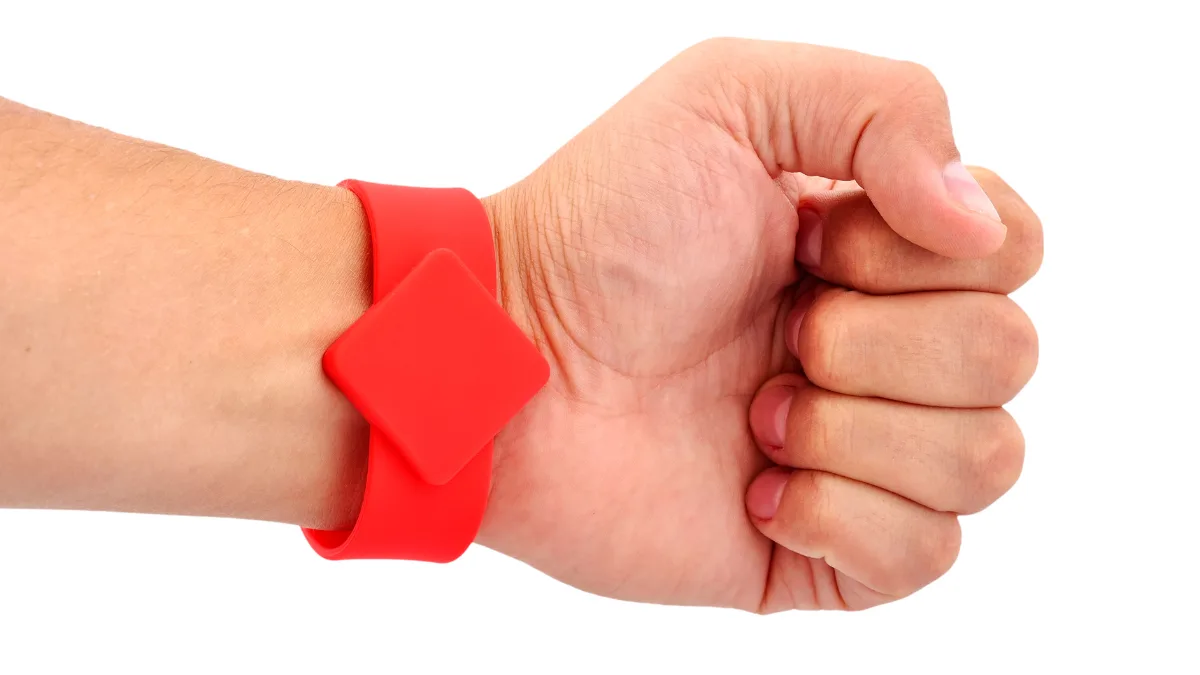
  • RFID Bracelets: Learn Its Functions and Applications

    RFID Bracelets: Learn Its Functions and Applications

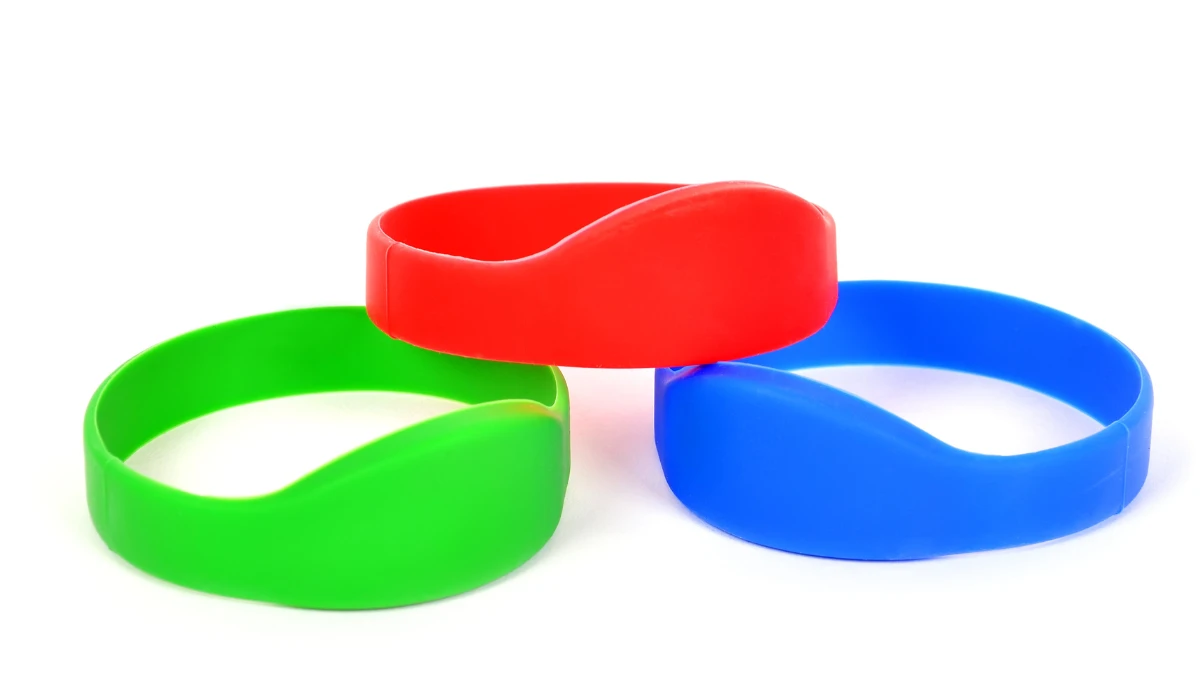
    The development of Radio Frequency Identification (RFID) has developed very rapidly. Until the last few years, we have seen many people at music festivals and amusement parks using RFID bracelets.

    RFID bracelets are used by the entertainment and recreation industry as a tool for access control entering locations.

    RFID bracelets operate to be able to locate participants in the venue, this is quite helpful for the security staff of the entertainment and recreation venue itself.

    In this article, we will explain the benefits of RFID bracelets, their applications, and their benefits in the entertainment and recreation industry.

    RFID Bracelets Function

    RFID Bracelets 3

    Many of you should have already used RFID bracelets to enter concerts, amusement parks, hotels, etc.

    But RFID bracelets have more functions than that, here are the functions of RFID bracelets:

    1. Payment: Wristband innovation permits clients to pay without cash, comparable to a credit card. Participants can include their installment data in the RFID tag sometime recently the event.
    2. Self Check-In: RFID frameworks speed up the check-in preparation, as they can be pre-authorized sometime recently being sent to the client, permitting them to check in once they arrive at the location.
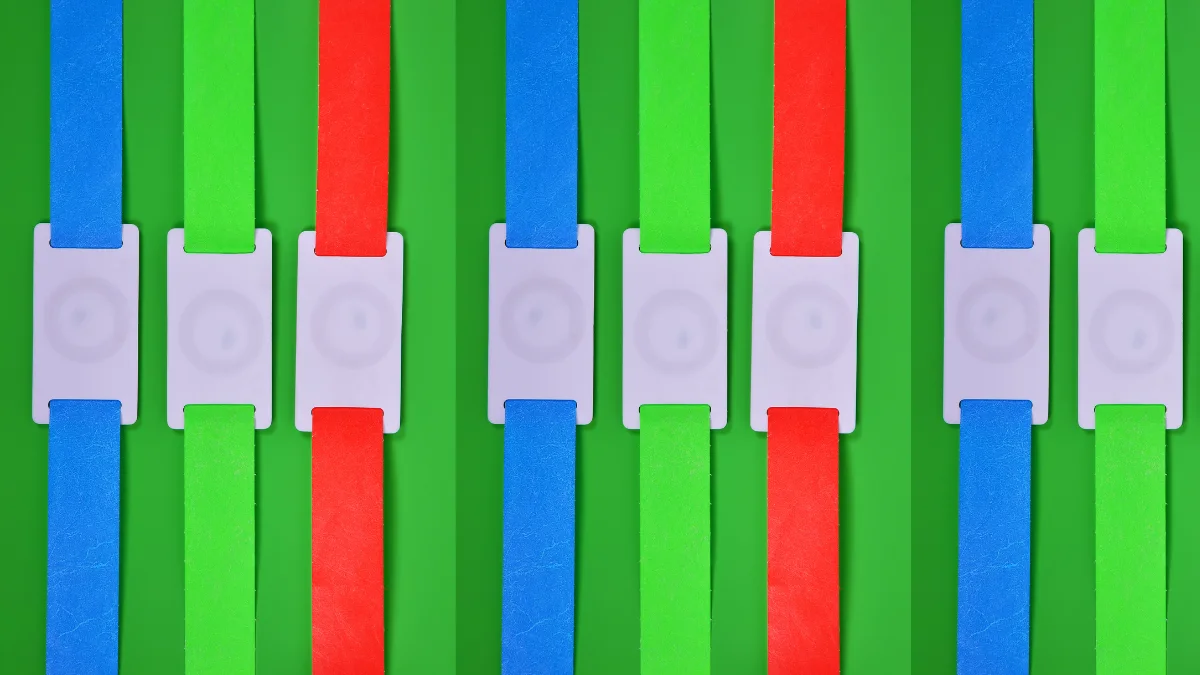
    3. Access Control: RFID wristbands can be filtered at the entrance, lessening the requirement to carry tickets to take an interest in an event.
    4. Real-Time Analysis: RFID frameworks can be of extraordinary offer assistance to organizers. They permit them to track active periods, line times, and prevalent attractions.
    5. Data transfer: RFID scanners have an encoded radio flag that distinguishes the tag, which is associated with a database with data approximately the customer.

    Applications and Benefits

    RFID Bracelets

    RFID wristbands have had many uses since their invention during World War II. Initially, RFID was used to identify whether an aircraft was a friend or foe.

    Today RFID has been used for payment processing, supply chain management, and even brand authentication.

    The following are the applications and benefits of RFID bracelets that have been implemented:

    1. Hotel management

    RFID bracelets for hotel management not only function as room cards but can be used for payment areas, access control, and other activities in hotel areas.

    In some hotels, guests can also upload photos of the hotel and activities to Facebook with the help of RFID technology, which brings tremendous exposure to the hotel and provides guests with a valuable interactive experience.

    2. Event management

    RFID wristbands in area management are used for concerts, sporting events, conferences, and other large-scale events. RFID wristbands are not only a smart and convenient ticket but also play an important role in other aspects.

    Among the benefits of utilizing RFID innovation amid occasions is the truth that participants can log in rapidly, as organizers can filter different wristbands at once, and they as it were required to wave them over the sensors. Utilizing RFID for occasions too implies that the occasion does not require more staff at the entrance.

    Another benefit that event organizers can get from RFID wristbands is the fact that it eliminates fraud. RFID wristbands can also help staff know how many people are present and plan accordingly.

    3. Entertainment center management

    Recreation centers such as swimming pools, gyms, water parks, amusement parks, and theaters also prefer RFID wristbands.

    RFID wristbands can greatly improve work efficiency and management level, effectively eliminate financial gaps, ensure enterprise economic benefits, and implement real-time monitoring and management in an all-around way.

    4. Transportation application

    The RFID bracelet has a payment function, so it can be used directly as a bus or metro card. It is very convenient for transportation, and you don’t have to worry about losing it like a card.

    5. Social media interaction

    In some hotels and entertainment venues that use RFID bracelets, customers can link their social media accounts to their bracelets. This allows venue owners to introduce their events and enhance the user experience.

    These are the various functions of RFID from its application and benefits in everyday life, especially those that have been used in the entertainment and tourism industry.

    Hopefully in the future RFID technology can innovate for other industries not only for the entertainment and tourism industry.

    For your information, it is very important to make sure the RFID that you use has been tested and has a certificate from the authority. we are ready to assist you for obtaining Type Approval for your products before being distributed to the global market. [UN]