
Bhutan Type Approval Summary
Bhutan is a relatively small telecommunications market in terms of economic value, but it has seen a surge in internet penetration that exceeds the global average. With an area of 38,394 km² and a population of approximately 800,000, the country has also widely adopted new technologies despite being hampered by its mountainous topography.
Given these developments, manufacturers and importers may consider Bhutan a potential market for their telecommunications devices. As a first step, it is important to understand the applicable compliance requirements.
These compliance requirements are known as “BICMA Type Approval.” BICMA stands for the Bhutan InfoComm and Media Authority, the government agency responsible for regulating the information and communications technology (ICT), telecommunications, media, and film sectors in Bhutan.
This agency was established in accordance with the provisions of the Bhutan Information, Communication, and Media Act of 2018. In an effort to provide and facilitate secure, reliable, and efficient ICT and telecommunications services, BICMA strictly enforces type approval.
This is an effort to ensure that all devices marketed and used in Bhutan meet the specified technical standards. As a result, telecommunications devices can be used safely and without causing interference.
Who Can Be an Applicant?
- Local representative
- Not required
There is no requirement to use a local representative to submit a type approval certification application in Bhutan. Applicants are not limited to local companies.
Foreign parties intending to market their ICT products in Bhutan may submit their applications directly to BICMA.
Application Method
- In-country testing
- No
- Paperwork only
- Yes
Local testing is not a common method for obtaining BICMA type approval certification. Instead, the Authority generally accepts applications based on paperwork or document evaluation.
Telecommunications devices intended for distribution in Bhutan must comply with the technical standards specified by the Authority. As the national regulatory body, BICMA recognizes standards issued by various national and international standardization organizations, including:
- International Telecommunication Union (ITU)
- International Organization for Standardization (ISO)
- American National Standards Institute (ANSI)
- European Telecommunications Standards Institute (ETSI)
- Telecommunications Industry Association (TIA)
- International Electrotechnical Commission (IEC)
- Institute of Electrical and Electronics Engineers (IEEE)
- Internet Engineering Task Force (IETF)
- Organization for the Advancement of Structured Information Standards (OASIS)
- 3rd Generation Partnership Project (3GPP)
- 3rd Generation Partnership Project 2 (3GPP2)
- Regional Asia Information Security Standards Exchange (RAISS) Forum
- Japanese Accreditation Board for Conformity Assessment (JAB)
To submit an application, BICMA requires test reports covering radio frequency (RF) performance, electromagnetic compatibility (EMC), and health and safety requirements. Applicants should ensure that testing is conducted in accordance with the applicable standards.
Please note that testing based on these recognized standards must be carried out by laboratories accredited by an accreditation body that is a member of the International Laboratory Accreditation Cooperation (ILAC) Mutual Recognition Arrangement (MRA).
Where certification has been issued by an internationally recognized certification body and the applicable standards comply with BICMA requirements (for example, EU/CE standards), a Certificate or Declaration of Conformity may be used to support the application. However, the relevant test reports must still be submitted.
The test reports, certificates, and other required documents must be submitted through the online portal provided by BICMA as part of the type approval application process.
Sample Requirements
BICMA does not require device samples as part of the application verification process. Local testing is not a mandatory requirement for type approval certification.
Generally, sample requirements apply only in countries where local testing is mandatory or where the authority requires further inspection of the telecommunications product.
Document Requirements
To obtain the Type Approval Certificate, the applicant shall submit an application with:
- Application Form
- Proof of payment
- Valid Business License
- Manufacturer's Declaration of Conformity
- Test report/certificate issued by any internationally accredited test laboratory recognized by the Authority
- Interconnection with the National Telecommunications Network (if the equipment is to be interconnected to the National Telecommunications Network)
Submission process
- Submission
- Online
In Bhutan, the submission process for type approval certification is conducted online. All required application documents must be submitted through the online portal provided by BICMA at https://www.citizenservices.gov.bt/NDI/?agency=Bicma.
To apply for certification through the portal, applicants must first register an account. The status of the application and any updates regarding its progress can be tracked through the portal.
Lead Time of Certification
- Lead time
- 1-6 weeks
BICMA does not publicly specify an official processing time for type approval applications. In practice, lead times are approximately one to six weeks, depending on the completeness of the application and supporting documentation.
Validity Period
- Validity
- Permanent
Type Approval Certificates are issued with indefinite validity, provided that no modifications are made to the approved device.
A new Type Approval Certificate must be obtained if a device that has already received type approval is modified with respect to the manufacturer's brand, product name, model number, functions, or any other changes that affect the information previously submitted to the Authority.
The certification process for obtaining a new certificate is the same as that for the initial application.
Label Requirements for Bhutan Type Approval
- Product label
- Required
- Approval mark
- Required
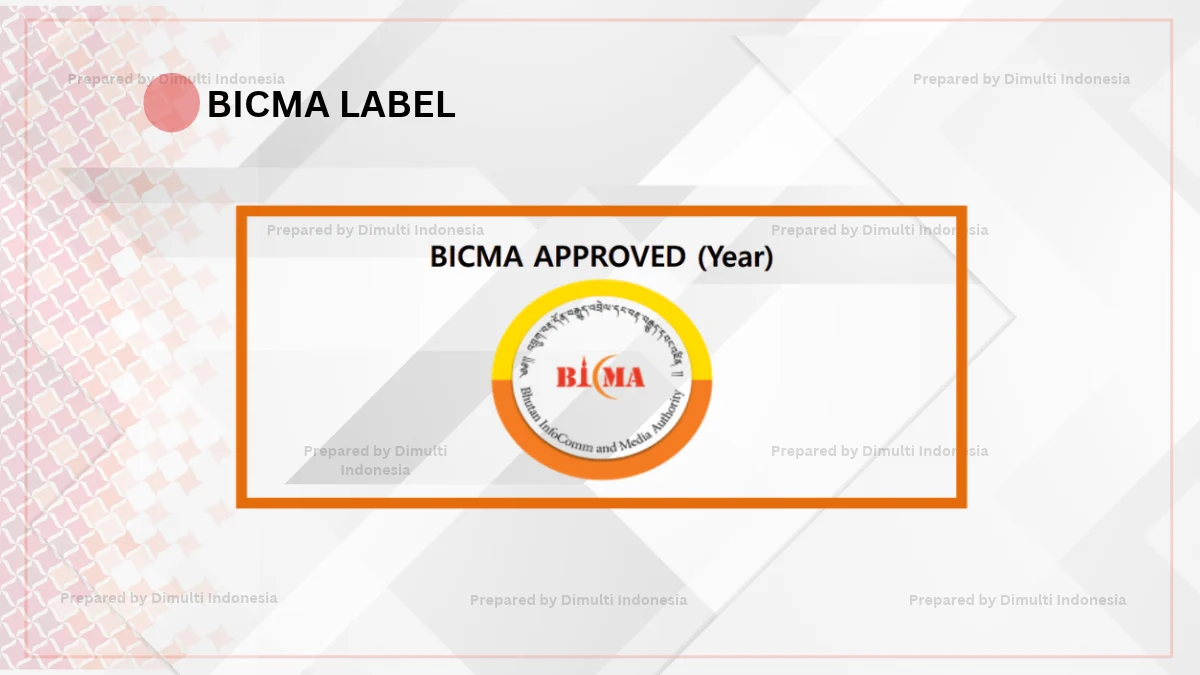
All equipment approved by the Authority must carry the label "Type Approved by BICMA."
BICMA Label
There is no specific format requirement for affixing the label. However, the label must be placed in a location that is clearly visible and legible to users.
Alternative Country Names
Druk-yul, Kingdom of Bhutan, Bhoetan, Botan, Butani, Bh2utan, Bhoutan, Regne de Bhutan, Kraljevina Butan, Butan, an Bhútáin, Bhotana, Butanas, Butão, Pūtani, Bhwtan, بوتان, 不丹, ブータン, 부탄, Бутан
Rules by Technology
Allowed, approval required
- Wi-Fi 2.4 GHz
- Wi-Fi 5 GHz
- Wi-Fi 6E (6 GHz)
- Wi-Fi 7
- Bluetooth Classic
- Bluetooth Low Energy
- NFC
- RFID
- UWB
- Zigbee
- Thread
- Z-Wave
- DECT
- 2G/3G
- 4G LTE
- 5G NR
- NB-IoT
- LTE-M
- LoRa / LoRaWAN
- Sigfox
- Automotive radar (77 GHz)
- Short-range radar (24 / 60 GHz)
- GNSS (GPS)
- Satellite communication
- Wireless charging (Qi)
- PMR / Walkie-talkie
- Amateur radio
- Passive Optical Network (PON)
- Wavelength Division Multiplexing (WDM)
- Coaxial Cable
- ISDN
- Ethernet
- VoIP
- IPv6
- Power Line Carrier
- Microwave Link
- Free Space Optics
- Digital Audio Broadcasting (DAB)
Talk to our project handler
Send your product details and we reply with the BICMA requirements, lead time and cost.
Request a quote