
South Africa Type Approval Summary
South Africa is regarded as a leader in the digital economy and has the most advanced telecommunications infrastructure on the African continent. According to DataReportal, the country has 51.7 million internet users and 127 million active mobile connections, reflecting high penetration rates in a population of about 63 million.
With a land area of 1,221,037 km², the South African telecommunications market presents unique structural challenges. The instability of the national electricity supply is a serious issue there, forcing operators to spend substantial costs to keep their operations running.
These challenges certainly do not deter manufacturers or importers from marketing and selling their telecommunications devices in Africa’s most advanced market. The first thing to understand before expanding into this market is the applicable compliance requirements. The compliance mechanism in South Africa is known as “ICASA Certification.”
ICASA stands for the Independent Communications Authority of South Africa. It is the official regulator of the communications, broadcasting, and postal services sectors in South Africa. This independent regulatory body was established under the ICASA Act No. 13 of 2000.
Under this law, ICASA has the authority to plan and manage the radio frequency spectrum, develop regulations, grant licenses, monitor licensee compliance, and protect consumers.
Therefore, manufacturers and importers need to obtain an ICASA type approval certificate before marketing their products in South Africa. This certificate is one of the keys to opening up new markets in the African region.
Who Can Be an Applicant?
- Local representative
- Required
Applications for ICASA Type Approval may only be submitted by companies registered in South Africa. These may include local manufacturers, local importers, local distributors, and local companies.
Foreign manufacturers cannot apply directly. They must appoint a local representative to act as the applicant for the certificate. ICASA will require information from the local company, such as the company’s registration number, physical address and mailing address, contact person’s name, and phone number.
Application Method
- In-country testing
- No
- Paperwork only
- Yes
South Africa requires local testing or document evaluation as the sole method for applying for type approval certification. Therefore, applicants must already have a test report for the submitted product from an ISO/IEC 17025-accredited laboratory, with standards aligned with the European Union (EU) approach.
In addition to the test report, applicants are also required to submit other required documents to the competent authority. ICASA will evaluate all of these documents to determine whether the application passes verification or not.
Sample Requirements
ICASA doesn't need sample requirements. Type approval certification applications are submitted by the paperwork method.
Document Requirements
Here's the list of document requirements:
- Name and Address of Local Representation
- Proof of Payment of the prescribed non-refundable Type Approval fee
- Safety Test Report
- EMC Test Report
- RF Test Report
- Health Test Report (if applicable)
- DoC (EU Declaration Of Conformity)
- Technical Specification of Product (Functional Description)
- Installation/User Manual
- Product Photos
- Schematic Diagram
- PCB Layout
Submission process
- Submission
- Online and offline
When submitting required documents, ICASA provides several methods that certificate applicants can use. Certification applications can be submitted in person or online. The following methods are permitted by the CRC:
- Delivered in person at ICASA’s headquarters during business hours
- Sent by registered mail to the headquarters, Private Bag X10002, Sandton, 2196
- Submitted electronically to the following address: TALapplications@icasa.org.za
Documents received by ICASA will be reviewed, and the results of the assessment will be communicated to the applicant. A Type Approval Certificate will be issued if the documents are approved.
However, the authority will issue a letter stating the reasons for the rejection of the application if the documents are deemed non-compliant. Applicants who receive a rejection letter may resubmit their Type Approval application by correcting any missing or incorrect information.
Lead Time of Certification
- Lead time
- 30-45 days
The lead time for type approval certification in South Africa is quite long. The paperwork-based process takes 30–45 days. Compared to some countries in Asia or on other continents, this is a relatively lengthy process.
Validity Period
- Validity
- Permanent
Type Approval in South Africa is valid for an indefinite period. However, this is subject to the condition that there are no modifications to the RF specifications or changes to technical standards that would render the Type Approval invalid.
Changes that are permitted and do not require a new type approval are cosmetic changes, such as changes in color, external design, casing, etc. These changes do not alter the technical information recorded in the Type Approval Register.
Label Requirements
- Product label
- Required
- Approval mark
- Required
- E-labeling
- Allowed
All equipment that has been type approved and received a type approval certificate must have a legible label permanently affixed to such equipment. The Authority shall conduct monitoring to ensure that equipment available in the Republic has been type approved and labelled.
ICASA Label
The minimum size of the ICASA logo shall be 3mm high and 3mm wide and the issued certificate number shall be 1mm high.
Format Label: TA XXXX-YYYY:
- TA stands for Type Approval
- XXXX is the year in which the Type Approval certificate was issued (e.g. 2011)
- YYYY is the sequential numbers issued by the Authority
The height to width ratio must be 1:2, e.g. 10 x 20 mm
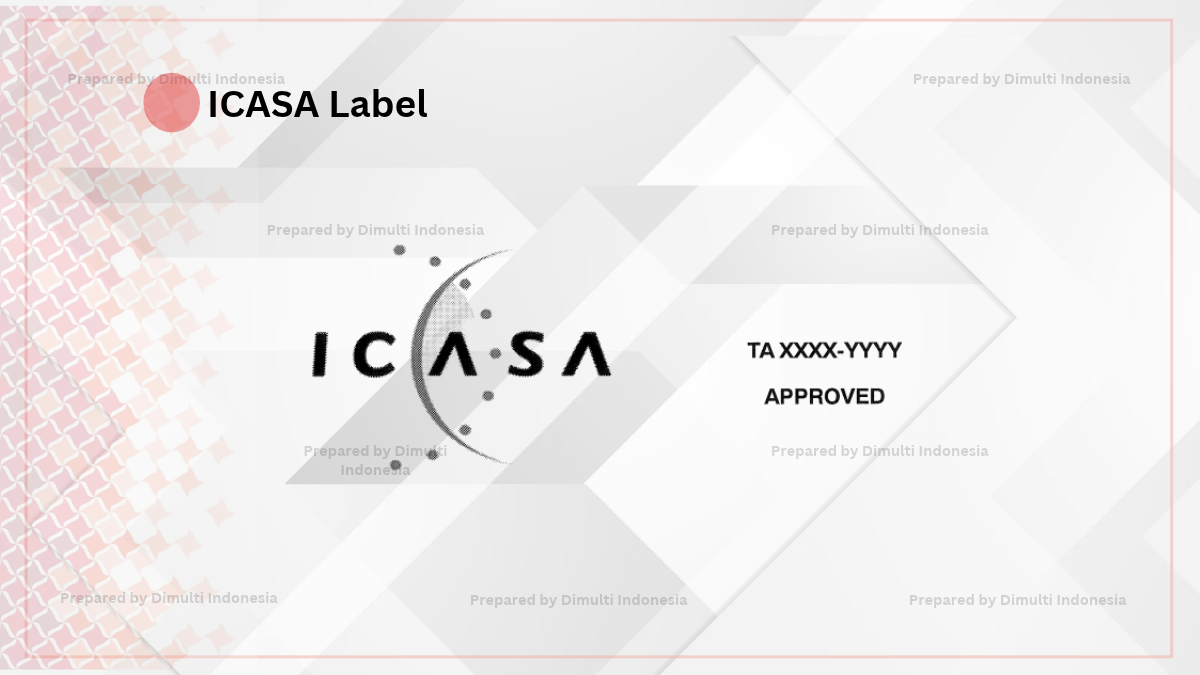
The label must be affixed to the equipment and the packaging and/or container before the equipment is made available for sale or lease or is supplied in any other manner.
The label must be protected against damage, such as scratching and ultraviolet (UV) exposure that may lead to the information on the labelling becoming illegible.
More on Labeling
In an instance where a supplier is of the view that a permanently affixed label is not feasible, a written request for an alternative method of displaying the label, including E-labelling, must be made to the Authority before supply or use of equipment.
In instances where e-labelling is used, the documentation accompanying the equipment must clearly explain how the user can access the label.
The E-labels must be displayed in at least one of the following methods:
- During the equipment's power up sequence
- Under the equipment's system information page
- Under the help menu on the equipment
Alternative Country Names
RSA, Suid-Afrika, Republic of South Africa, Republik Südafrika, Afrique du Sud, Južnoafrička Republika, Sud Africa, República de Sudáfrica, Южно-Африканская Республика, 南アフリカ, Südafrika, Sydafrika, 남아프리카, ZA, Sudáfrica
Rules by Technology
Allowed, approval required
- Wi-Fi 2.4 GHz
- Wi-Fi 5 GHz
- Wi-Fi 6E (6 GHz)
- Wi-Fi 7
- Bluetooth Classic
- Bluetooth Low Energy
- NFC
- RFID
- UWB
- Zigbee
- Thread
- Z-Wave
- DECT
- 2G/3G
- 4G LTE
- 5G NR
- NB-IoT
- LTE-M
- LoRa / LoRaWAN
- Sigfox
- Automotive radar (77 GHz)
- Short-range radar (24 / 60 GHz)
- GNSS (GPS)
- Satellite communication
- Wireless charging (Qi)
- PMR / Walkie-talkie
- Amateur radio
- Passive Optical Network (PON)
- Wavelength Division Multiplexing (WDM)
- Coaxial Cable
- ISDN
- Ethernet
- VoIP
- IPv6
- Power Line Carrier
- Microwave Link
- Free Space Optics
- Digital Audio Broadcasting (DAB)
Talk to our project handler
Send your product details and we reply with the ICASA requirements, lead time and cost.
Request a quote