
Nigeria Type Approval Summary
Nigeria is the largest and most dynamic Information and Communications Technology (ICT) market in Africa. According to the Nigerian Communications Commission (NCC), Nigeria leads sub-Saharan Africa in terms of digital economy value, mobile penetration, and user base.
Mobile service penetration stands at about 87%, with more than 172 million active subscribers. In terms of smartphone users, Nigeria ranks ninth, with over 140 million users, 86% of whom use Android.
With an area of 923,769 km² and a population of over 220 million, Nigeria is a major magnet for private investment. This naturally attracts manufacturers and importers looking to market their ICT devices there.
Before entering the Nigerian market, the first thing to understand is the compliance requirements in place there. This process is known as the “NCC Type Approval Certificate.”
This certification process is fully regulated by the NCC, an independent agency for the communications industry in Nigeria. Its responsibilities include fostering a conducive environment for telecommunications, ensuring high-quality services, and establishing a licensing and regulatory framework.
Within the scope of type approval, the NCC is responsible for device usage and marketing, the management of testing laboratories, conducting technical evaluations, and issuing certificates. It also carries out market surveillance, investigations, and enforcement actions in cases of non-compliance.
To enter the most dynamic ICT market in Africa, the first step is to understand the NCC type approval process and requirements. This will make it easier for manufacturers and importers to market their products in Nigeria.
Who Can Be an Applicant?
- Local representative
- Not required
Applicants for type approval certification in Nigeria are not limited to local Nigerian companies. Anyone who provides communication services, manufactures, or supplies communication equipment may apply for certification directly.
Application Method
- In-country testing
- Yes
- Paperwork only
- Yes
There are two paths available for applying for type approval certification in Nigeria: local testing and paperwork. For those who choose local testing, the testing will be conducted at testing laboratories accredited by the Commission in various regions of Nigeria.
For applicants who choose the documentation evaluation method, the test report must be from a foreign testing laboratory accredited by an international accreditation body under the Mutual Recognition Arrangement within the International Laboratory Accreditation Cooperation.
The type approval standards established by the NCC are based on international standards from the International Electrotechnical Commission (IEC) and its subsidiary, the International Special Committee on Radio Interference (CISPR), as well as the European Committee for Electrotechnical Standardization (CENELEC) and the European Telecommunications Standards Institute (ETSI).
If testing is to be conducted by a laboratory or accreditation body other than those designated by the Commission, the credentials of such body must be submitted for prior approval by the Commission.
Paperwork Only
Test results must be obtained from a foreign laboratory in accordance with NCC regulations.
Sample Requirements
For applicants who choose the local route, testing will require the submission of sample requirements. The type and number of test samples requested by the commission will depend on the type of device and the tests being conducted.
Document Requirements
Here's the list of document requirements:
- Application Form
- A Declaration of Conformity (DoC)
- A brief technical description of the equipment
- User manual or other information supplied with the equipment
- Circuit diagrams and PCB layouts
- Photographs of both the interior assembly and exterior of the product
- Test report
Submission process
- Submission
- Online
Applications for type approval certification in Nigeria are submitted online. All required documents must be submitted to the platform designated by the authorities.
Through this platform, applicants can check the status of their application. If the documents pass the evaluation, the certificate will be issued immediately. However, if the application is rejected, the applicant will be asked to complete the necessary documents and resubmit them.
Lead Time of Certification
- Lead time
- 30 days
According to the regulations established by the NCC, certification will be processed within one month of the Commission’s receipt of all required documents. The local testing process is not included in this lead time.
Local testing will take several additional weeks and must be completed before the documents are submitted. If any documents are incomplete or incorrect, the certification process will also take longer.
Validity Period
- Validity
- Permanent
NCC type approval certificates have no expiration date. Certificate holders may use them to import and market their ICT devices as long as there are no modifications to the RF specifications.
Product changes that may affect compliance with the Type Approval Standards listed in the Declaration of Conformity must be tested and evaluated by the Equipment Holder. Applications for a type approval modification certificate must be submitted by completing the designated application form.
Label Requirements
- Product label
- Required
- Approval mark
- Required
- E-labeling
- Allowed
All type approved equipment shall bear the mark of the Commission as well as a durable label. The label should be located close to
the model for identification. The label may also be on the packaging and user manual.
Where for reasons of size or other design features the product itself cannot be marked, the applicant shall include the label in the documentation, manual and or packaging accompanying each product.
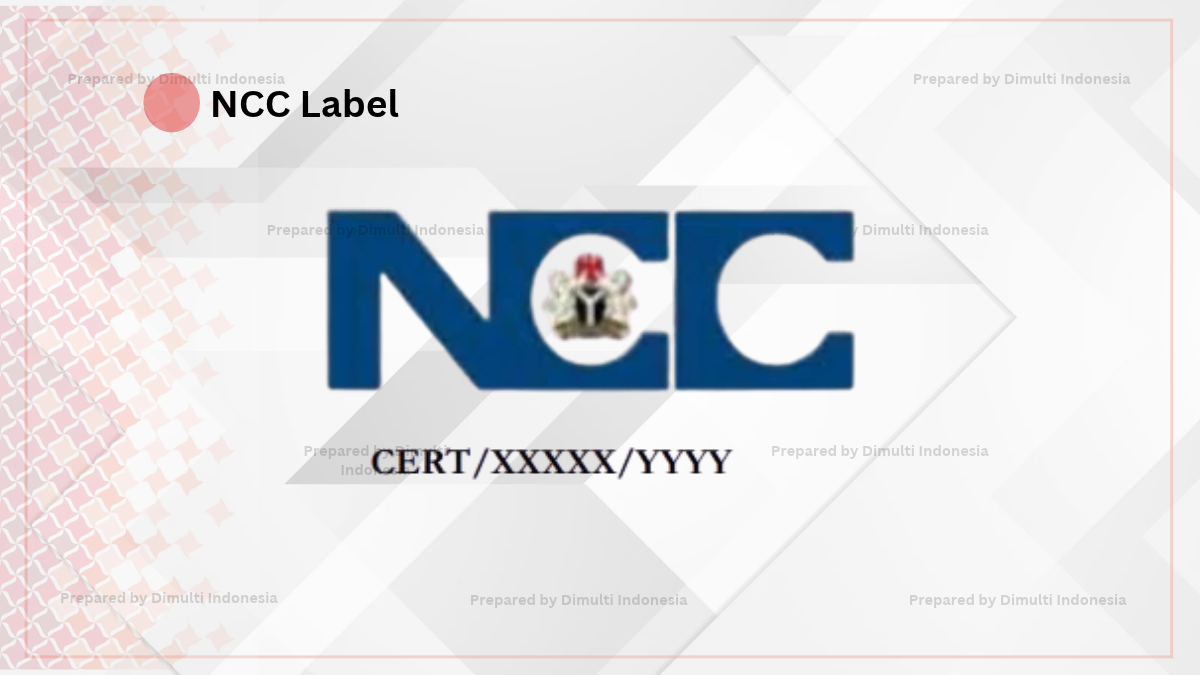
NCC Label
xxxx = the certificate number as contained in the Type Approval Certificate
yyyy= represents the year of Type Approval
Labeling Requirements:
- The characters shall appear in black print against a white background.
- The characters may differ in font from those in the example above
- The characters may differ in font from those in the example above
- The label may differ in width, height and number of lines from the example above.
- Placement of the label shall be in accordance with Section 11 of the Type Approval Business Rules.
More on Labeling
For devices with digital display and or with remote login capabilities, the Commission may permit the use of elabelling on the device as an alternative to physical labeling.
In the event of e-labelling being used on devices with digital display and or with remote login capabilities, the manufacturer shall also have a label on the packaging.
Alternative Country Names
Nijeriya, Naíjíríà, Federal Republic of Nigeria, Nigéria, Nigerija, Нигерия, ナイジェリア, 나이지리아, NG
Rules by Technology
Allowed, approval required
- Wi-Fi 2.4 GHz
- Wi-Fi 5 GHz
- Wi-Fi 6E (6 GHz)
- Wi-Fi 7
- Bluetooth Classic
- Bluetooth Low Energy
- NFC
- RFID
- UWB
- Zigbee
- Thread
- Z-Wave
- DECT
- 2G/3G
- 4G LTE
- 5G NR
- NB-IoT
- LTE-M
- LoRa / LoRaWAN
- Sigfox
- Automotive radar (77 GHz)
- Short-range radar (24 / 60 GHz)
- GNSS (GPS)
- Satellite communication
- Wireless charging (Qi)
- PMR / Walkie-talkie
- Amateur radio
- Passive Optical Network (PON)
- Wavelength Division Multiplexing (WDM)
- Coaxial Cable
- ISDN
- Ethernet
- VoIP
- IPv6
- Power Line Carrier
- Microwave Link
- Free Space Optics
- Digital Audio Broadcasting (DAB)
Talk to our project handler
Send your product details and we reply with the NCC requirements, lead time and cost.
Request a quote